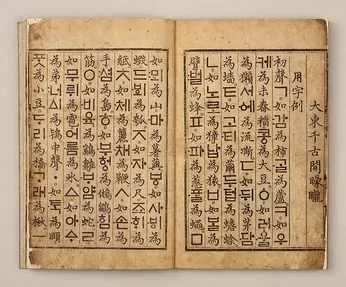
한글을 처음 배우면 이런 글자부터 만납니다.
When you first learn Hangeul, you meet letters like these:
ㄱ ㄴ ㅁ ㅅ ㅇ
ㅏ ㅓ ㅗ ㅜ ㅡ ㅣ
단순한 선과 점처럼 보이지요. 하지만 이 모양들은 아무렇게나 만들어진 것이 아닙니다.
They may look like simple lines and shapes. But these letters were not designed randomly.
자음에는 사람이 소리를 내는 모습이, 모음에는 하늘·땅·사람을 바라보던 생각이 담겨 있습니다.
The consonants reflect how sounds are produced, while the vowels grew from ideas about heaven, earth, and human beings.
오늘은 『훈민정음 해례본』을 따라 한글이 어떻게 만들어졌는지 살펴볼게요.
Let's look inside the Hunminjeongeum Haerye and discover how Hangeul was designed.
1. ‘한글’의 처음 이름은 훈민정음이었어요
Hangeul Was Originally Called Hunminjeongeum
세종대왕이 새로운 문자를 만들었을 때 지금처럼 ‘한글’이라고 부르지는 않았습니다.
When the new writing system was created during the reign of King Sejong the Great, it was not yet called Hangeul.
새 문자의 이름은 훈민정음(訓民正音)이었습니다.
The new writing system was called Hunminjeongeum (훈민정음, 訓民正音).
훈민정음 | Hunminjeongeum
백성을 가르치는 바른 소리
“The correct sounds for the instruction of the people.”
세종은 1443년에 새로운 문자를 창제했고, 1446년에 이를 세상에 반포했습니다.
King Sejong completed the new writing system in 1443, and Hunminjeongeum was officially proclaimed in 1446.
처음 만들어진 훈민정음은 28자였습니다. 이후 일부 글자가 더 이상 사용되지 않으면서 오늘날의 한글 체계가 되었습니다.
The original Hunminjeongeum consisted of 28 letters. Some of those letters later disappeared from everyday use, giving us the modern Hangeul system we use today.
2. 우리는 한글이 만들어진 원리를 어떻게 알까요?
How Do We Know How Hangeul Was Designed?
그 답을 알려주는 중요한 책이 바로 『훈민정음 해례본』입니다.
One of the most important sources is the Hunminjeongeum Haerye, a document explaining the principles behind the new writing system.
‘해례(解例)’는 원리를 풀어 설명하고 예를 보여준다는 뜻입니다.
The word Haerye (해례, 解例) refers to explanations and examples that show how the system works.
『훈민정음 해례본』에는 새 문자를 만든 목적뿐 아니라 글자의 소리, 운용 방법, 창제 원리와 사용 예까지 설명되어 있습니다.
The book explains not only why the writing system was created, but also how the letters represent sounds, how they are used, and the principles behind their design.
1446년에 간행된 이 책은 한글의 창제 원리를 이해하는 핵심 자료이며, 1997년 유네스코 세계기록유산에 등재되었습니다.
Published in 1446, the Hunminjeongeum Haerye is a key historical source for understanding Hangeul. It was inscribed on UNESCO's Memory of the World Register in 1997.
링크: https://www.unesco.org/en/memory-world
Memory of the World
Preservation of Amadou Hampâté Bâ's Documentary Treasures - Memory of the World Programme The preservation of Amadou Hampâté Bâ's manuscripts is safeguarded by the Amadou Hampâté Bâ Foundation, with assistance from the Republic of Korea and UNESCO
www.unesco.org
3. 자음은 소리를 내는 기관의 모습을 본떴어요
Consonants Reflect the Speech Organs
한글 기본 자음의 모양은 발음할 때 사용하는 기관의 모습을 바탕으로 만들어졌습니다.
The shapes of the basic Hangeul consonants were designed to reflect the speech organs used to produce their sounds.
ㄱ — 혀뿌리가 목구멍을 막는 모습
the shape of the tongue blocking the throat
ㄴ — 혀끝이 윗잇몸에 닿는 모습
the shape of the tongue touching the upper gums
ㅁ — 입의 모양
the shape of the mouth
ㅅ — 이의 모양
the shape of the teeth
ㅇ — 목구멍의 모양
the shape of the throat
즉, 글자의 모양과 소리를 내는 방법이 서로 연결되어 있습니다.
In other words, the shape of the letter is connected to the way the sound is produced.
한국어를 처음 배우는 사람에게도 이 원리를 알고 자음을 보면 글자가 단순한 기호가 아니라 하나의 작은 발음 그림처럼 보이기 시작합니다.
Once you understand this principle, Hangeul consonants can begin to look less like arbitrary symbols and more like small diagrams of pronunciation.
4. 기본 글자에 획을 더하면 새로운 소리가 됩니다
Adding Strokes Creates Related Sounds
기본 자음에 획을 더해 관련된 소리를 나타내는 글자를 만들기도 했습니다.
Additional strokes were added to some basic consonants to create letters representing related but different sounds.
ㄱ → ㅋ
ㄴ → ㄷ → ㅌ
ㅁ → ㅂ → ㅍ
ㅅ → ㅈ → ㅊ
이런 원리를 가획이라고 합니다.
This principle is called gahwaek (가획), meaning the addition of strokes.
그래서 한글은 글자를 하나하나 따로 외우기보다 서로 어떤 관계가 있는지를 살펴보면 구조가 훨씬 잘 보입니다.
Instead of memorizing every consonant as an unrelated shape, look for the relationships among them. The logic of Hangeul becomes much easier to see.
5. 모음에는 하늘·땅·사람이 담겨 있어요
Vowels Began with Heaven, Earth, and Human
훈민정음의 기본 모음은 세 가지 요소에서 출발합니다.
The original basic vowels were built from three symbolic elements.
ㆍ 하늘 | Heaven
ㅡ 땅 | Earth
ㅣ 사람 | Human
이 세 요소를 결합하여 다른 모음들이 만들어졌습니다.
Other vowels were formed by combining these basic elements in different ways.
오늘날에는 아래아 ㆍ를 일반적인 한글 표기에서 사용하지 않습니다. 하지만 한글이 처음 만들어진 원리를 이해할 때는 매우 중요한 글자입니다.
The dot-shaped vowel ㆍ, known as arae-a (아래아), is no longer part of ordinary modern Korean spelling. However, it remains important for understanding the original design of Hangeul vowels.
6. 한글은 글자를 모아 하나의 음절을 만듭니다
Hangeul Letters Form Syllable Blocks
영어 알파벳은 글자를 옆으로 이어 씁니다.
In English, alphabet letters are normally written one after another in a line.
H + A + N
한글에서는 자음과 모음을 하나의 네모난 공간 안에 모아 음절 블록(syllable block)을 만듭니다.
Hangeul works differently. Consonants and vowels are grouped together into a square-shaped syllable block.
ㄱ + ㅏ = 가
ㅎ + ㅏ + ㄴ = 한
그래서 한글을 배울 때는 글자 하나하나를 익히는 것과 동시에 자음과 모음이 어떻게 하나의 음절을 만드는지 이해하는 것이 중요합니다.
That is why learning Hangeul is not only about memorizing individual letters. You also need to understand how consonants and vowels come together to form syllables.
7. 잠깐 퀴즈!
Quick Quiz
1. 훈민정음을 만든 왕은 누구일까요?
Who created Hunminjeongeum?
① 세종대왕 King Sejong ② 이순신 Yi Sun-sin ③ 정조 King Jeongjo
2. 『훈민정음 해례본』은 무엇을 설명할까요?
What does the Hunminjeongeum Haerye explain?
① 한국 음식 Korean food
② 한글의 창제 원리와 사용법 The principles and use of Hangeul
③ 조선의 지도 Maps of Joseon
3. 기본 자음 ㅁ은 무엇의 모양을 본떴을까요?
What does the basic consonant ㅁ represent?
① 입 Mouth ② 눈 Eye ③ 손 Hand
4. 기본 모음 ㅣ는 무엇을 상징할까요?
What does the basic vowel ㅣ symbolize?
① 하늘 Heaven ② 땅 Earth ③ 사람 Human
5. ㄱ과 ㅏ를 합치면 어떤 글자가 될까요?
What do you get when you combine ㄱ and ㅏ?
① 거 ② 가 ③ 고
✔ 정답 | Answers
1. ① 세종대왕 2. ② 한글의 창제 원리와 사용법 3. ① 입 4. ③ 사람 5. ② 가
8. 오늘 기억할 것
What to Remember Today
한국어는 언어입니다.
Korean is a language.
한글은 한국어를 쓰는 문자 체계입니다.
Hangeul is the writing system used to write Korean.
한글은 세종대왕 시대에 만들어졌습니다.
Hangeul was created during the reign of King Sejong the Great.
한글의 자음과 모음에는 글자를 만든 원리가 있습니다.
Hangeul consonants and vowels were designed according to systematic principles.
그래서 한글을 배울 때 단순히 글자를 외우는 것보다 왜 이런 모양이 되었는지 함께 살펴보면 훨씬 재미있습니다.
So when you learn Hangeul, don't just memorize the letters. Ask why they look the way they do. Once you see the ideas behind the shapes, the Korean alphabet becomes much more interesting—and often much easier to remember.
함께 읽기 | Read Together
한글날이 왜 10월 9일인지 궁금하다면 「한글날은 왜 10월 9일일까요?」도 함께 읽어보세요.
Wondering why Hangeul Day is celebrated on October 9? Read Part 1, “Why Is Hangeul Day on October 9?”
글 링크: 바로 가기
Seoul Zian
Korean Language · Korean Culture · Seoul
Learn Korean, discover Korea.
© Seoul Zian. All rights reserved.
#한글 #한글날 #훈민정음 #훈민정음해례본 #세종대왕 #한글창제원리 #한글자음 #한글모음 #한국어 #한국어공부 #한국문화 #Hangeul #Hunminjeongeum #KingSejong #LearnKorean #KoreanAlphabet #KoreanCulture #SeoulZian
'진짜 한국어 Real Korean' 카테고리의 다른 글
| 한글날은 왜 10월 9일일까요?|Why Is Hangeul Day on October 9?|한글날 100주년 (0) | 2026.10.04 |
|---|---|
| 요즘 한국어|“육각형 인간”이 뭐예요?|요즘 한국에서 자주 쓰는 말 (0) | 2026.10.03 |
| ‘야르’ 뜻이 뭐예요?|요즘 다시 유행하는 한국어 '야르' (1) | 2026.09.30 |
| 메타버스 세종학당에서 한국어 말하기 선생님으로 활동했습니다|지금은 어디서 배울까요? (0) | 2026.09.26 |
| 5학년 한국사: 📜 단군신화와 홍익인간📜 The Dangun Myth and the Idea of Hongik Ingan (1) | 2025.09.07 |


