📍 Part 3. 세종한국어 1A 연계
Sejong Korean 1A|Lesson 3 Connection
한국어 초급 12강|사물과 위치
Objects & Locations|Seoul Zian Korean Level 1-12
눈앞에 있는 물건의 이름을 모르거나, 물건이 어디에 있는지 묻고 싶을 때는 어떻게 말할까요?
What can you say when you do not know the name of an object or want to ask where something is?
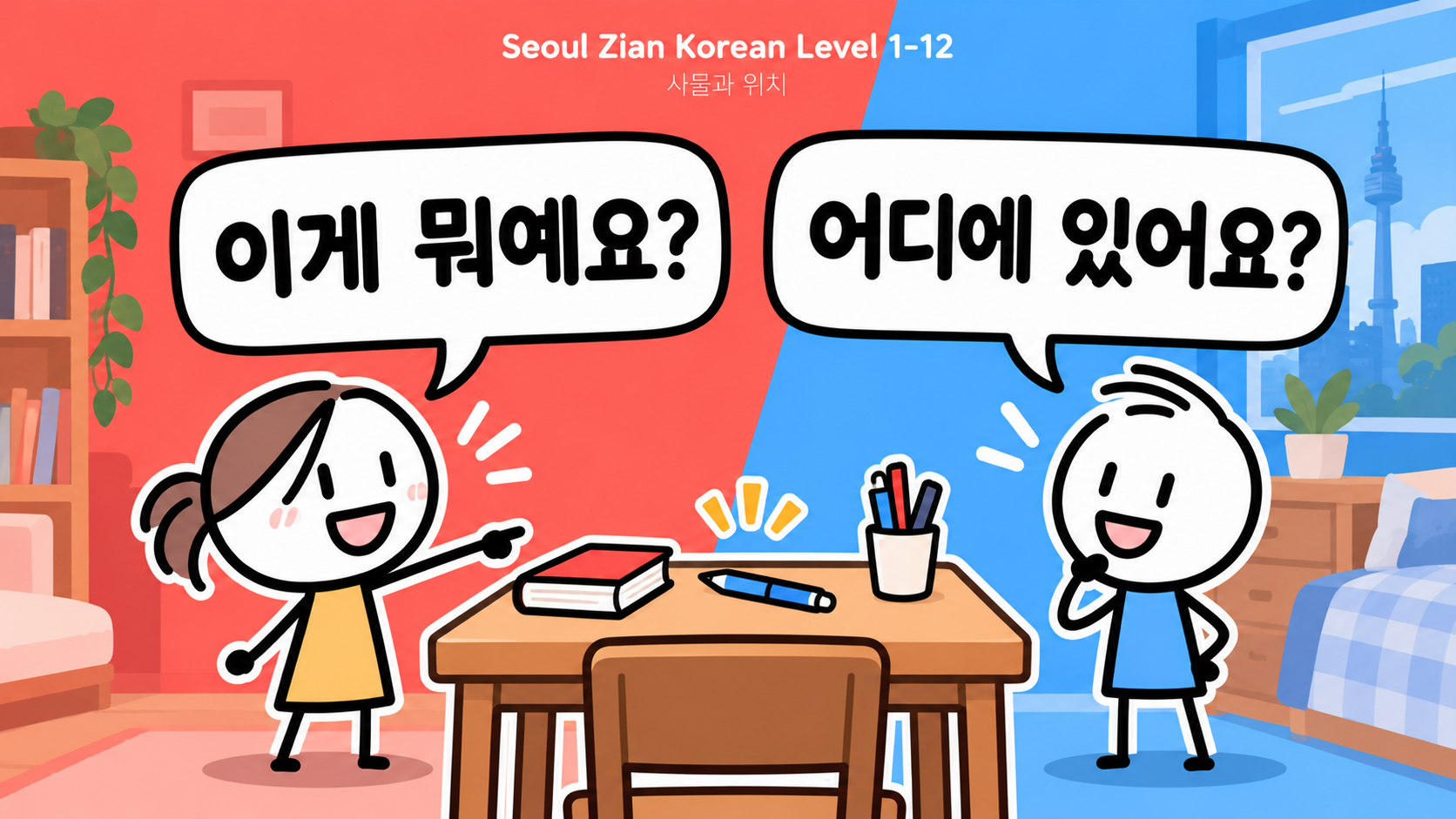
이게 뭐예요?
What's this?
책이에요.
It's a book.
책이 어디에 있어요?
Where is the book?
책상 위에 있어요.
It's on the desk.
이번 강에서는 주변 사물의 이름을 묻고, 위치를 설명하는 기본 표현을 배웁니다.
In this lesson, you will learn how to identify everyday objects and describe where they are.
🎯 학습 목표 | Learning Goal
이 수업이 끝나면 다음을 할 수 있습니다.
By the end of this lesson, you will be able to:
- 주변 사물의 이름을 묻고 답할 수 있습니다.
Ask for and give the names of everyday objects. - 이/그/저를 사용해 가까운 것과 먼 것을 가리킬 수 있습니다.
Use 이/그/저 to point to things at different distances. - 위, 아래, 앞, 뒤, 옆과 같은 위치 표현을 사용할 수 있습니다.
Use basic location words such as above, below, in front of, behind, and beside. - 에 있어요/없어요를 사용해 사람이나 사물의 위치를 말할 수 있습니다.
Use 에 있어요/없어요 to say where a person or object is or is not.
📚 세종한국어 연계 | Sejong Korean Connection
《세종한국어 1A》의 사물·위치 표현 학습 흐름과 연계
이번 강에서는 주변 사물을 가리키고, 사물의 이름과 위치를 묻고 답하는 기본적인 의사소통을 연습합니다.
In this lesson, learners practice identifying nearby objects and asking and answering where things are.
Seoul Zian에서는 실제 교실과 집, 온라인 수업에서 자주 만나는 사물을 중심으로 새로운 예문과 활동을 구성합니다.
Seoul Zian uses original examples and activities based on familiar objects from classrooms, homes, and online lessons.
🌏 국제 통용 한국어 수준 | Korean Curriculum Level
초급 1급 | Beginner Level 1
주변의 익숙한 사물과 장소를 간단하게 지칭하고 위치를 설명하는 단계입니다.
At this level, learners begin to identify familiar objects and describe simple locations.
💬 먼저 말해 봐요 | Speak First
문법 설명보다 먼저 눈앞에 있는 물건을 보면서 문장 전체를 말해 보세요.
Before studying grammar, look at real objects around you and practice the complete expressions.
이게 뭐예요?
What's this?
펜이에요.
It's a pen.
펜이 어디에 있어요?
Where is the pen?
책 옆에 있어요.
It's next to the book.
🎒 교실과 집의 물건 | Everyday Objects
먼저 주변에서 자주 볼 수 있는 물건 이름을 익혀 봅시다.
First, learn the names of some common objects around you.
책 — book
공책 — notebook
펜 — pen
연필 — pencil
지우개 — eraser
가방 — bag
휴대전화 — mobile phone
컴퓨터 — computer
컵 — cup
열쇠 — key
👉 이거, 그거, 저거 | This, That, That Over There
물건을 가리킬 때 거리에 따라 표현이 달라집니다.
Korean uses different words depending on the distance between the speaker, listener, and object.
👇 이거
this thing — near the speaker
👉 그거
that thing — near the listener or already mentioned
👉··· 저거
that thing over there — far from both speaker and listener
처음에는 실제 물건을 손으로 가리키면서 연습하면 훨씬 쉽게 익힐 수 있습니다.
At first, practice by physically pointing to objects. It makes these expressions much easier to understand.
❓ 이게 뭐예요? | What's This?
11강에서 배운 뭐예요?를 이번에는 사물과 함께 사용해 봅니다.
In Lesson 11, you learned 뭐예요?. Now let's use it to ask about objects.
A: 이게 뭐예요?
What's this?
B: 공책이에요.
It's a notebook.
A: 저게 뭐예요?
What's that over there?
B: 가방이에요.
It's a bag.
📍 위치 표현 | Location Words
사물이 어디에 있는지 말하려면 다음 위치 표현을 익혀 두세요.
Learn these basic location words to describe where something is.
아래 — under / below
앞 — in front of
뒤 — behind
옆 — beside / next to
안 — inside
밖 — outside
🧱 위치 표현을 만들어 봐요 | Build a Location Phrase
한국어에서는 기준이 되는 명사 뒤에 위치 단어를 붙입니다.
In Korean, the location word usually comes after the reference noun.
의자 + 아래 → 의자 아래
문 + 앞 → 문 앞
컴퓨터 + 뒤 → 컴퓨터 뒤
책 + 옆 → 책 옆
가방 + 안 → 가방 안
💬 미니 대화 1 | Mini Dialogue 1
상황: 수업 중 처음 보는 물건을 발견했어요.
Situation: You see an unfamiliar object during class.
👩 Anna: 이게 뭐예요?
What's this?
👨 준호: 지우개예요.
It's an eraser.
👩 Anna: 그럼 저게 뭐예요?
Then what's that over there?
👨 준호: 연필깎이예요.
It's a pencil sharpener.
📍 미니 대화 2 | Mini Dialogue 2
상황: 휴대전화를 찾고 있어요.
Situation: You are looking for your phone.
👩 Anna: 휴대전화가 어디에 있어요?
Where is the phone?
👨 준호: 책상 위에 있어요.
It's on the desk.
👩 Anna: 가방 안에 있어요?
Is it inside the bag?
👨 준호: 아니요, 가방 안에는 없어요.
No, it isn't in the bag.
🧩 문법 1|이 / 그 / 저
이/그/저는 명사 앞에서 사물이나 사람을 가리킬 때 사용합니다.
이/그/저 come before a noun and help indicate which person or thing you mean.
이 + 책 → 이 책
this book
그 + 가방 → 그 가방
that bag
저 + 사람 → 저 사람
that person over there
이것/그것/저것 또는 회화에서 자주 쓰는 이거/그거/저거와 함께 익혀 두면 좋습니다.
It is also useful to learn 이것/그것/저것 and their common spoken forms 이거/그거/저거.
🧩 문법 2|에 있어요 / 없어요
사람이나 사물이 어떤 장소에 존재할 때 에 있어요를 사용합니다.
Use 에 있어요 to say that a person or thing is at or in a particular place.
책이 책상 위에 있어요.
The book is on the desk.
열쇠가 가방 안에 있어요.
The key is in the bag.
휴대전화가 책상 위에 없어요.
The phone is not on the desk.
기본 문장 구조는 이렇게 생각하면 쉽습니다.
You can think of the basic sentence pattern like this:
❓ 어디에 있어요? | Where Is It?
위치를 모를 때는 어디에 있어요?라고 묻습니다.
Use 어디에 있어요? to ask where a person or thing is.
책이 어디에 있어요?
Where is the book?
가방이 어디에 있어요?
Where is the bag?
선생님이 어디에 있어요?
Where is the teacher?
🔊 발음 | Pronunciation
위치 문장은 단어마다 끊기보다 의미 단위로 묶어서 읽어 보세요.
Instead of pausing after every word, group the sentence into meaningful chunks.
책이 / 어디에 있어요?
책상 위에 / 있어요.
가방 안에는 / 없어요.
질문할 때는 마지막을 지나치게 올리기보다 자연스럽게 이어 말해 보세요.
Keep the question intonation natural rather than raising the final syllable too sharply.
🇰🇷 진짜 한국어 | Real Korean
교과서에서는 이것이 뭐예요? 같은 형태를 볼 수 있지만, 실제 대화에서는 이게 뭐예요?라고 말하는 경우가 매우 많습니다.
In textbooks, you may see forms such as 이것이 뭐예요?, but in everyday conversation, 이게 뭐예요? is very common.
이것이 뭐예요?
More complete/formal structure
이게 뭐예요?
Very common in everyday speech
초급 단계에서는 두 표현을 모두 이해하되, 실제 말하기에서는 자연스러운 회화 표현도 함께 익혀 두는 것이 좋습니다.
At beginner level, it is useful to understand both forms while also becoming familiar with the version commonly used in conversation.
💡 문화 노트 | Culture Note
한국어에서 사람을 직접 손가락으로 가리키면서 저 사람이라고 말하면 상황에 따라 무례하게 느껴질 수 있습니다.
In Korean culture, directly pointing at a person while saying 저 사람 can sometimes feel impolite.
물건을 가리키는 연습에는 문제가 없지만, 사람을 이야기할 때는 손가락으로 직접 가리키기보다 시선이나 상황으로 자연스럽게 표현하는 편이 좋습니다.
Pointing is fine when practicing with objects, but when referring to people, it is usually more polite not to point directly with your finger.
📖 핵심 어휘 | Key Vocabulary
이거
this thing
그거
that thing
저거
that thing over there
어디
where
위
on / above
아래
under / below
앞
in front
뒤
behind
옆
next to / beside
안
inside
밖
outside
있어요
there is / have / is located
없어요
there isn't / don't have / is not located
👀 보고 바로 말해 보세요 | Look and Respond
지금 주변을 둘러보고 실제 물건으로 연습해 보세요.
Look around you and practice with real objects.
1. 가까이에 있는 물건을 가리키며 → 이게 뭐예요?
2. 조금 떨어진 물건을 가리키며 → 저게 뭐예요?
3. 책을 보고 → 책이 어디에 있어요?
4. 휴대전화를 보고 → 휴대전화가 책상 위에 있어요.
5. 없는 물건을 보고 → 가방 안에 없어요.
✏️ 직접 해보기 | Try It
알맞은 표현을 넣어 문장을 완성해 보세요.
Complete each sentence with the best expression.
1.
A: _____ 뭐예요?
B: 책이에요.
2.
A: 책이 _____ 있어요?
B: 책상 위에 있어요.
3.
열쇠가 가방 _____ 있어요.
4.
휴대전화가 책상 위에 ________.
(The phone is not on the desk.)
⏱️ 30분 수업이라면 | For a 30-Minute Lesson
30분 수업에서는 이 강을 두 차시로 나누어 학습할 수 있습니다.
For a 30-minute class, this lesson can be divided into two sessions.
사물 어휘 → 이거/그거/저거 → 이게 뭐예요? → 위치 어휘 → 실제 물건으로 말하기
Object vocabulary → this/that → asking what something is → location words → speaking with real objects
이/그/저 → 에 있어요/없어요 → 어디에 있어요? → 발음 → 위치 설명 역할극
이/그/저 → 에 있어요/없어요 → asking where something is → pronunciation → location role-play
✅ 미니 퀴즈 | Mini Quiz
1. 가까이에 있는 물건을 가리킬 때 가장 알맞은 표현은?
Which word is best for something near the speaker?
① 이거
② 그거
③ 저거
2. “What's this?”는 한국어로?
① 어디에 있어요?
② 이게 뭐예요?
③ 저 사람이에요?
3. 빈칸에 알맞은 것을 고르세요.
책이 책상 위___ 있어요.
① 를
② 에
③ 는
4. “The key is in the bag.”은?
① 열쇠가 가방 안에 있어요.
② 열쇠가 가방 뒤예요.
③ 열쇠가 가방에 뭐예요?
5. “The phone isn't on the desk.”은?
① 휴대전화가 책상 위에 있어요.
② 휴대전화가 책상 위에 없어요.
③ 휴대전화가 어디예요?
✔ 정답 | Answers
1. ① 이거
2. ② 이게 뭐예요?
3. ② 에
4. ① 열쇠가 가방 안에 있어요.
5. ② 휴대전화가 책상 위에 없어요.
🌱 오늘 기억할 것 | What to Remember Today
👉 이게 뭐예요?
What's this?
📖 책이에요.
It's a book.
📍 책이 어디에 있어요?
Where is the book?
🪑 책상 위에 있어요.
It's on the desk.
❌ 가방 안에는 없어요.
It isn't in the bag.
이제 주변 물건의 이름과 위치를 한국어로 말할 수 있어요!
Now I can identify objects and say where they are in Korean!
다음 강 | Next Lesson
다음 강에서는 공부해요, 먹어요, 일해요처럼 지금 무엇을 하는지 말하는 기본 동사를 배웁니다.
In the next lesson, you will learn basic verbs for talking about everyday actions such as studying, eating, and working.
© Seoul Zian
Korean language and culture through lessons, stories, sound and play.
#이게뭐예요 #어디에있어요 #한국어위치표현 #이거그거저거 #한국어조사 #에있어요 #한국어초급12강 #초급한국어 #한국어배우기 #한국어공부 #한국어회화 #한국어문법 #한국어어휘 #세종한국어1A #한국어교재 #LearnKorean #KoreanLocation #KoreanObjects #BeginnerKorean #KoreanGrammar #KoreanVocabulary #KoreanForBeginners #KoreanLanguage #SeoulZian #SeoulZianKorean


